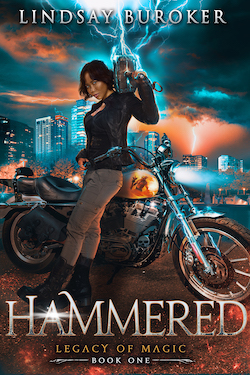
Whether you’re an urban fantasy fan new to my work or have read and enjoyed my Death Before Dragons books, and have been hoping for more in that world, I have a new series for you!
Legacy of Magic brings you:
- A kickass heroine with a magical hammer…
- A mysterious elf assassin with a past…
- Snark, adventure, romance and…
- Cheese! (Hey, girls gotta have snacks in between battles.)
You can order the ebook or paperback (audiobook in the works) today.
For those who like a sneak peak before deciding to buy, here are the opening chapters:
Chapter 1
 “I didn’t think the police used chalk outlines anymore.” I tried not to feel uneasy about the faded drawing on the floor of the foyer in the house I’d just purchased.
Correction: my small home-renovations business had purchased it. On the advice of my goblin assistant, whom I’d encouraged to take more initiative. Why was I already sure that had been a mistake?
“Maybe a neighbor child with sidewalk chalk was responsible.” Tinja waved airily, cog-and-charm bracelets rattling on her green wrist. “I have observed that human offspring will draw on anything.”
“Oh sure. And they often wander into locked vacant homes to do their graffiti work.”
Tinja nodded, missing the sarcasm. Unlike me, she hadn’t been born on Earth, so I couldn’t expect her to catch such nuances.
“The owner of the house was killed here, right?” I asked. “It’s why we got a deal.”
A steal of a deal. I’d never remodeled a house in Bellevue at all, much less one in the prestigious Bridle Trails neighborhood, with houses on acre lots located a stone’s throw from a huge equestrian park. As I eyed the mid-century-modern “diamond in the rough,” as the listing had called it, I worried this would be too much to handle.
“It was the renter who was killed, not the owner.”
“Well, that makes it all right then. Are those bullet holes?” I probed one of several finger-width gaps in the cedar-plank wall of the foyer. Had there been anything magical about the bullets, I might have sensed them lodged in the wood, a talent my half-dwarf heritage gave me. Apparently, this had been a run-of-the-mill mundane homicide.
“Easy to fix with your spickle, right?” Tinja asked.
“It’s called Spackle, and you can’t apply it to cedar.”
“We will get new boards then. If we want boards at all. This cedar is not as tacky as the faux-wood paneling in the last house I drew plans for, but it is not suitably modern. Not this much of it anyway. An accent wall would perhaps be acceptable. Come, Matti. I will show you my blueprints. They’re amazing.” Tinja patted the rolled papers under her arm and ambled toward the kitchen, her tool belt clanking.
I wondered if her professors at the university found her supreme confidence warranted. Or if any of them knew she was a goblin. Tinja was enrolled solely in online courses, which did not require she walk her three-and-a-half-foot-tall green-skinned and white-haired body into a classroom.
Before following her, I considered the position of the holes to estimate where the bullets had been fired from. Not from the street and through a window or the front door—not that I’d expected drive-by shootings in Bridle Trails—but from the living room. Had someone been lying in wait for the poor homeowner—renter—when he’d come home?
Maybe I shouldn’t have left my war hammer—all that I had left of my dwarven mother—in the truck. Usually, I used it for demoing drywall and cabinets, a purpose the dwarven smith who’d made it surely hadn’t intended, but I’d been known to thump bad guys with it.
“Come, Matti,” Tinja called regally. “Do you not wish to see the plans?”
“You’re my assistant, you know. You’re the one who’s supposed to be at my beck and call.” Despite the words, I headed toward the back of the house, peering into rooms along the way. At four thousand square feet, the two-story house wasn’t as large as some in the neighborhood, but seeing all the spaces that needed remodeling had the adding machine in my mind tallying thousands of dollars’ worth of supplies. Not to mention Tinja’s plans involved a master-suite addition over the garage.
“You may beck-and-call me if you wish, but unless you’re waving your hammer around, I’m rarely intimidated enough to drop everything and come.”
“My body-builder physique doesn’t make you quake in your work pants?” I flexed my biceps as I stepped into the kitchen, but the horror of avocado appliances, linoleum floors patterned in green squares, and chartreuse-striped cushions on the banquet table stole my humor. “The cedar planks were beautiful in comparison to this.”
“Have you not said you enjoy a challenge?”
“I guess Abbas and I have fixed up worse,” I said, mentioning my business partner.
“Certainly. There’s not even a mildew, cat-urine, or wet-dog smell in this home, not like in the last one, which featured all of those and more. Not that I’d expect your dwarven nose to take note. Dwarves are used to living in all manner of underground miasmas, after all. On their home world, some of the resorts involve steam chambers where you bathe in sulfuric gases.”
“The human half of my nose did note the urine odor.” I’d never heard of dwarven resorts and suspected she’d made that up.
“Ah, it is good to know that it is capable. Humans are not known for their sublime senses.” Tinja patted a faded laminate countertop. “Overall, this house has been very well cared for. Many things will be simple to renovate in here, and the kitchen is very spacious. Look, we can add a wine cellar in that nook. Or, I suppose you would prefer a cheese cellar for your fancy wheels of cheddar.” She grinned at me, aware of my favorite snack.
“I’m not the end buyer.” As if I could afford this neighborhood for myself. “And for your information, it would be Camembert or Roquefort and a cheese cave, not a cellar.”
“Don’t you keep yours in the carrot crisper?”
“The vegetable crisper, yes. Because there’s no room in my tiny house for a cheese cave.” I touched a backsplash tile that emanated a hint of magic. My finger tingled slightly. I’d only been inside for five minutes, and this was already the oddest project I’d taken on. “I wouldn’t even be able to fit a roommate in my house if she wasn’t three feet tall.”
“Three and a half feet.” Tinja jumped, spread her arms wide, and spun a pirouette, almost whacking me with her blueprints. “Matti, I wish you to make more money on this house than the last one. You barely broke even and paid me only a portion of what I’m worth.”
“You’re a student. Most students don’t get paid much at all. And Abbas and I don’t typically use blueprints.”
“You didn’t used to use them. In the savage and woeful days before you met me. But now I am here. You must do as other house flippers do to maximize profits.”
“I really wouldn’t need an architect then. Most flippers only paint, replace drawer pulls, and do other minimal—and cheap—fixes.” Maybe it was my mother’s blood, but I couldn’t bring myself to do anything less than the best I could with the money and materials I could scrounge. I was a craftswoman, not simply a house flipper.
“There must be a center ground.”
“Middle ground.”
“Yes. We will discuss it more later. Now, back to business. I am afraid that this free-standing circular fireplace does not belong in the kitchen, and I have removed it from my design. It impedes the flow and is not up to modern building codes.” Tinja tapped wrought-iron fireplace tools mounted on the brick below the open hearth and shook her head. “I am learning about human building codes in my classes. They are most quirky. Your hammer is capable of demolishing bricks, yes?”
“Bricks, metal doors, murderers’ heads…” I touched one of the window frames, envisioning replacing the old aluminum with wood. “They’ve all fallen to my mighty—” Something large and furry darted through the backyard, and my senses twanged. Whatever it was, it was magical. “What was that?”
“I believe it is a shifter of some kind,” Tinja said as I pressed my nose to the window to peer out. “A werewolf, maybe? I assume they are common here.”
“You assume werewolf shifters are common in a hoity-toity neighborhood in the most expensive metro area in Washington?”
“There are many trees and ferns, which wolves like very much. They are similar to elves and enjoy nature. Except they hunt in and pee on the nature instead of using it to calm their senses and enhance their magic.”
“No wolf better be peeing in my new yard.” I squinted into the overrun morass that was far more representative of the nature she’d mentioned than a yard. Creeping buttercups had smothered someone’s attempt at growing grass, Himalayan blackberry bushes encroached on an ancient moss-covered patio, and towering firs, pines, and cedars ensured that little afternoon sunlight made it to the ground.
“If he has, you can apply your hammer to his head.”
Leaves quivered on a rhododendron threatening to consume an old swing set, and I sensed the shifter hiding in the foliage. I couldn’t see him, but I felt him. As with magical bullets, my senses could detect those with magical blood.
“What do you think he’s doing?” I whispered.
“Probably what I said wolves like to do in nature.”
“He’s not doing that.” I hoped. “This is private property. Our private property. I’m going to get my hammer.”
Before I’d taken more than a few steps, glass shattered in the living room. I sensed a second magical being, one leaping through the freshly broken window… A fit man in his thirties with a thick beard and mustache, he landed in a crouch, facing me. Despite his human form, he snarled, his dark eyes locking on to me.
Before he moved, my instincts told me he would spring. I darted back into the kitchen and grabbed the fireplace poker from the tool set. As he charged through the doorway, I spun and swung the pointed rod like I would have my hammer.
He saw it coming and tried to duck, but I’d swung many a weapon over the years and was fast. It caught him in the forehead. Had my hammer struck him, he would have flown across the room and into the far wall. The poker lacked its heft, but the blow halted him, and he yowled like a wild animal.
“What are you doing in my house?” I demanded, pulling the poker back for another swing if necessary.
Fur sprouted from his bare arms, and his face contorted, nose and jaw elongating into something lupine.
Knowing he would be more dangerous in his wolf form, I swung again.
This time, he anticipated the blow. Ducking, he charged under the tool and toward me. Not surprised, I whirled and launched a spinning side kick into his gut. His abs were as hard as a brick wall, but my heel connected with enough power to make him stagger back.
Thanking my grandmother for putting me in martial arts as a kid, I hefted the poker to crack him on the head again. I wanted to knock him out or at least convince him to jump back out the window and get off the property.
“The other one is coming,” Tinja blurted before I struck. She knelt on the countertop as she peered out the window. “Uh oh. Make that the other two. I didn’t sense that one before. Maybe he has a charm that camouflages him.”
Damn it, why had I left my hammer in the truck? I did not want to fight two at once. Three if this one stuck around.
“Never mind.” Tinja lowered a wrench that she’d intended to use as a weapon. “Is that an elf? Here, on Earth? How startling.”
Before the shifter in the kitchen could attack again, I slammed the poker down on his head. Worried we would face more enemies, I didn’t soften the blow, and the strength I’d inherited from my mother dropped him hard. If he’d been fully human, it might have done lasting damage—something my martial-arts instructor would have berated me soundly for—but werewolf heads had the sturdy resilience of concrete blocks.
Tinja swore. Then whistled. What did that mean?
After the shifter passed out, I snatched a sidearm out of his belt holster, threw it into the fireplace, and ran to the window, bumping shoulders with Tinja. The second and third werewolves had shifted into their lupine forms and charged out of the bushes—or maybe been dragged out of them. With their heads almost as high as a man’s, their powerful bodies covered in black fur, and their jaws snapping like steel traps, they battled a foe even more unexpected than werewolves.
A pointy-eared elf in a green cloak, brown trousers, beige tunic—was that buckskin?—and low brown boots wielded two longswords ambidextrously. I’d never seen a full-blooded elf in my life. They’d supposedly all left Earth back before I’d been born. What was he doing here?
Working together, both wolves leaped for his throat, their teeth flashing. With a stern but unconcerned expression on his face, the elf dedicated one sword to each and parried their snapping jaws without giving ground.
They were powerful and had him outnumbered, but his movements were so fast and fluid that I didn’t doubt for a moment that he would win. In fact, he could have finished them at any time.
His eyes narrowed slightly, and one wolf jerked his head back, as if he’d been stung. Or… attacked mentally? I’d heard that full-blooded magical beings could speak telepathically, read minds, and interrogate people with a thought, but I’d never seen it.
“He’s beautiful,” Tinja whispered.
“Which one?” I assumed she meant the elf, as he was handsome, with intense blue eyes, a perfectly straight nose, and short blond hair that accentuated his pronounced cheekbones. But with goblin tastes, who knew?
“The elf.”
The werewolf that had shaken his head backed away from the fight as the other tried to distract the elf. He shifted into his human form, then rolled naked into nearby bushes, reaching for something. Not overly distracted, the elf kept watching him, even as his twin swords blurred, shifting from defense to offense. With a powerful blow, he lopped off the attacking wolf’s head so startlingly cleanly that I would have known his blades were magical even if I hadn’t sensed them.
“Ack.” Tinja scrambled off the counter and flung her hands over her eyes. “Gruesome!”
As the head landed with a sickening thud on the mossy patio, I couldn’t disagree. The other werewolf rolled away from the bushes with a gun in hand.
“Look out!” I blurted, not sure if the elf was familiar with firearms. He looked like he’d stepped out of The Lord of the Rings.
Not glancing toward us, he strode toward the werewolf. His enemy fired twice, aiming for his chest.
Blades blurring again, the elf deflected both bullets, and I could only gape. Even with magic, I wouldn’t have thought that was possible.
Cursing, the werewolf fired twice more, but the elf thwarted the attack again, even from scant feet away. The bullets ricocheted into the side of the house, making me duck while thinking of the bullet holes in the foyer.
Though I should have flattened myself to the floor, as Tinja wisely did, I couldn’t keep from peering over the windowsill. Before the werewolf could fire again, the elf sprang, slicing a blade through his enemy’s wrist. It cut off the hand holding the gun, and the firearm flew free. It struck a drainpipe with a clang. I had no idea where the hand went.
As the werewolf screamed, the elf struck again. For a second time in twenty seconds, someone was decapitated in front of my eyes.
It slowly dawned on me that warning the elf might not have been wise. He might be prettier than the werewolves, but that didn’t mean he was a good guy.
What if he disliked half-blooded dwarves as much as werewolves?
Chapter 2
“Is it safe to look?” Tinja had risen from the floor but still had her hands over her eyes.
Outside, it had grown silent, the birds and squirrels that had been chattering earlier not making a peep.
“Not if you don’t want to see two guys’ bloody heads.” I grimaced, not wanting to see that myself, but until I found out if the elf would be a threat to me, I wouldn’t close the shutters on him.
“Gross.”
On the patio, the elf drew a square of cloth from a pocket. He fastidiously cleaned his swords before sheathing them, the blood somehow not staining the cloth, then put it away and removed a slender backpack. He plucked free what looked like a large red-velvet bag, shook it out, and picked up the first head by the hair. After tucking it into the bag, he went for the second.
In death, werewolves reverted to human form, which made watching their decapitated heads being stuck in a bag all the more disturbing. With another shake, the bag flattened, and the elf folded it.
I’d heard of magical items, such as charms that could allow the wearer some specific and usually trivial power, but this guy had everything out of a Dungeons & Dragons compendium.
As the elf returned the neatly folded bag of heads to his backpack, I looked around the interior of the house, gaze lingering on the unconscious werewolf on the floor. “We did not negotiate hard enough for this property.”
“It was already four hundred thousand under market value,” Tinja said. “I did research. As you taught me.”
“That was still too much. Way too much.”
As the elf donned his backpack again, he looked through the window at us, his blue eyes flinty and cold, as if promising we were next.
“Shit.” I slunk away from the window. “I’m getting my hammer. You better hide.”
After watching his battle, I worried he would kick my ass even if I did get to my hammer in time, but I would go down fighting.
This time, as I ran through the house, broken glass crunching under my shoes, I made it to the front door. A second before I pulled it open, something splatted against the wood. Several somethings.
Now what?
I rose on tiptoes to peer through the peephole, wishing I had a few more inches of height. A familiar truck painted with black tiger stripes idled in the street, the driver hanging halfway out as he raised his arm to throw again. More idiots jeered and pointed from the bed in the back.
If I hadn’t needed my hammer, and also recognized a woman darting from the walkway into the shrubs, I wouldn’t have opened the door. As I did, wrinkling my nose at a rotten-egg smell, the driver dropped back into the seat.
“Freaks!” he hollered, then gunned his truck and drove off, almost clipping my old beater. It and a sporty EV were parked in the street.
The woman in the shrubs—Zadie, my real estate agent—yelled, “Shit heads!” after them.
Broken shells littered the stoop, and the liquid remains of the eggs dribbled down the door. At least it hadn’t been a flaming bag of dog droppings this time.
If I hadn’t been worried about the elf, I would have been furious at the ongoing antics of my unasked-for rivals, but I had bigger problems.
“Who were those guys?” Zadie asked. “There can’t possibly be gangs in this neighborhood.”
“Rival flippers. I beat them out of a property we were both bidding on once, sold it for less than they would have, and they’ve decided to turn into high-school bullies and torment me now. Are you okay?” Though I should have helped brush leaves off her, we weren’t alone on the property. I ran past her and yanked open the truck door to pull out my hammer.
The double-headed weapon radiated magic, and its familiar heft was comforting in my hands. With it, maybe I could hold my own against an elf.
“I’m not used to being pelted by eggs when I walk up to a client’s house. That usually only happens in my neighborhood.” Zadie stepped back onto the walkway, brushing off her top, which appeared to be egg-free.
“I thought you lived in a good part of town.”
“I do, but I’m kind of an odd duck, you know.” Dark-skinned Zadie, with her eyebrow rings, nose piercings, and Starfleet Academy logo on her messenger bag, gave me an arch look. “That’s why I like hanging out with your group. It’s the only time I’m not the weirdest one in the room.”
“Is it safe?” came Tinja’s plaintive call from the doorway. “My wrenches and screwdrivers are quivering with fear.”
“Definitely not the weirdest,” Zadie said.
“That’s the truth.” As far as I knew, Zadie was 100 percent human, versus me, Tinja, and Abbas, my half-troll partner who paused drywalling and painting periodically throughout the day to pray, half the time for his mother’s Muslim religion and half the time for his father’s shamanic troll religion. He observed an inordinate amount of holidays for his dual beliefs. Fortunately, he was a gifted craftsman and made up for the copious time off. “Though your penchant for swishing wine around in your mouth before spitting it out is a little strange.”
As we spoke, I crept to the side of the house and peered through the undergrowth toward the backyard, surprised the elf hadn’t made an appearance yet. Had he gone inside? I assumed he wasn’t enjoying the whimsy of the rusty swing set.
“Wine tasting is perfectly normal.” Zadie trailed me around the side of the house, though she had to be wondering what I was looking for. “You spit it out after you taste it so you don’t get drunk before you get to try everything. Rich old guys at wine clubs do the same thing.”
“Just who we should let define our normal.”
I sprang around the corner of the house and into the backyard with my hammer poised, ready in case the elf was still on the patio. He wasn’t. But the two decapitated bodies were.
I swore. What was I supposed to do with those?
Zadie saw them and swore even harder. She lunged back around the corner of the house and covered her eyes. Her voice got squeaky as she asked, “Why are there naked dead guys on the patio?”
“Because Tinja got the house for four hundred thousand off market value, and it came with some quirks.” I peered into the overgrown bushes and trees edging the yard and reached out with my senses, but I couldn’t detect the elf’s magical blood. Now that I thought about it, I hadn’t sensed him when he’d been fighting the werewolves either. That was strange. Usually, full-blooded magical beings glowed like beacons to my senses.
“Headless dead guys are more than quirks.”
“I’ll get them cleaned up.” How, I didn’t yet know. Even though I fancied myself a bit of a secret crimefighter, I didn’t make a habit of killing people. I only thumped them around to ensure proper behavior. What did one do with shifter bodies? Put them in a barrel and dump them in the lake? Mafia-style? “I wouldn’t want you to have to mention them in the listing.”
“There’s a lot about this house I wouldn’t mention in a listing in its current state.” Zadie backed farther away from the corner, not lowering her hand until she stumbled on a broken paver. She gripped her knees and took a few steadying breaths before continuing. “At least it’s in a great neighborhood. And quite the departure from your usual blue-collar flips. Inasmuch as there’s blue-collar anything left in the greater Seattle area. You say Tinja picked it out?”
“Yeah. She’s encouraging me to go higher end so we can make more of a profit.” Never mind that I preferred fixing up houses for people who couldn’t afford to pay for remodeling on their own. I raised my voice and called into the bushes, “Hey, elf-dude. Would you mind folding up the bodies in your funky bag as well as the heads? This is littering.” I waved toward the patio.
Zadie stared at me. “I’m definitely not the weird one here.”
“Ha ha.” When no response came from the bushes, I returned to the front yard.
The elf was waiting on the sidewalk, his weapons sheathed in scabbards on his back and his arms folded over his chest.
Cursing, I jerked my hammer up and dropped into a fighting crouch.
He gazed at me with interest. No, he gazed at me with bland indifference, but he eyed the hammer with interest.
That happened often. Even if one knew nothing about dwarves or the runes etched on the haft and sides of the heads, the large silver weapon looked badass. I wished I knew more about it, besides that it had belonged to my mother.
“Uh.” Zadie stepped behind me. She was a half a head taller than I was, so she would have to crouch if she wanted to use me as a shield, but she must have been curious about him, because she didn’t. “Who is that?” she whispered.
“Who the hell are you?” I called to the elf.
The direct approach had always been my style.
“Where did you get that weapon?” he asked in English, though he had an accent I couldn’t place.
Since almost all elves and dwarves had left Earth forty years earlier, returning to their home worlds through portals that some of them could create, there weren’t many full-bloods around. I had a feeling this guy wasn’t a local.
“My mother.” I drew myself up to my full five feet one inches, wishing I wasn’t still a foot shorter than he. “What’s it to you?” My grip tightened on the haft. Was it possible he’d come because he wanted it? Numerous times over the years, people with half- or quarter-magical blood had sensed its power and tried to take it from me. From a young age, I’d gotten used to defending myself.
“You did not steal it?” His sky-blue eyes gazed into mine, as if he were trying to read my mind. It was unnerving.
“Of course not.” For some reason, I almost added that my mother had died when I was four, my father had been carted off to military prison for killing some of the soldiers who’d been responsible, and my oblivious-to-all-things-magical half-sister had once tried to save me from being weird by throwing the hammer in the river. But what business was it of his? “Where did you get your weapons?”
They were at least as magical as mine.
“I won them in battle.”
Won them in battle? That made it sound like he’d stolen them, as he was accusing me of doing. Killing the owner before taking something didn’t make it less of a theft.
“You forgot to answer my introductory question,” I said. “Who are you? And why were you killing those guys on my lawn?”
The elf gazed toward the house. I sensed the remaining werewolf inside—he hadn’t moved and was hopefully still unconscious. If I could sense him, the elf could too. I hoped he didn’t plan to go in and decapitate the guy.
“The two I slew were werewolf shifters from Osgashandril,” he said calmly. “Not guys.” The way he carefully pronounced that made me think the word was unfamiliar to him. “Before joining a local pack on this world, they stole from an orc princess. Her mother hired me to ensure they will steal no more.”
“By killing them?”
I surreptitiously released the haft of the hammer to wipe one sweaty palm, then the other. The elf made me nervous. Though I hated to admit it, it wasn’t entirely because I’d seen him fight and worried he would attack me. As Tinja had pointed out, he was strikingly handsome, and I always got flustered talking to those types.
My teenage years were long past, but I’d never stopped being awkward around hot guys. It was that tangle of emotions that came over me in their presence, the longing for them to notice me even as I braced myself to cringe when they inevitably said something cruel. Or ignored me altogether.
That awkwardness had been understandable in high school, when I’d been the oddly strong girl who’d beaten all the boys at sports, something that had earned me far more derision than admiration, but I was a thirty-four-year-old successful businesswoman. Or at least one who wasn’t mired in bone-crushing debt. You’d think I would have grown some self-confidence by now. And I had. But not in this area…
“Yes.” The elf lifted his chin. “I am Varlesh Sarrlevi, traveler, mage, warrior, and accomplished assassin on more than twelve worlds.” He glanced at the hammer again before gazing expectantly at me.
“I’m Matti.”
His gaze continued unwaveringly, as if my introduction hadn’t been sufficient. Maybe he was trying to figure out how a scruffy half-dwarf and half-Samoan woman could have ended up with a magical hammer.
“Mataalii Puletasi,” I said, giving him my full name, though I still didn’t see what business it was of his. “Neither my kindergarten teacher nor the kids in my class could say Mataalii, so it got turned into Matti.”
“I have noticed that many humans in this part of your world struggle with names of more than one syllable. What was the name of your dwarf progenitor?”
“My mother? Dad called her Roxy.”
He looked blankly at me. Yeah, that wasn’t a dwarf name.
“You know, like Rocks. Because she was really strong, even more muscled than me, and when she got mad and yelled, her voice sounded like rocks grinding together.” At least she hadn’t had a beard, something I’d heard some dwarf women could and did grow.
His stare continued. I couldn’t tell if he didn’t understand me fully or did and didn’t believe me.
“It was apparently sexier than it sounded because my dad was super into her,” I added.
“Why are you telling him this?” Zadie whispered over my shoulder.
Good question.
“He has more weapons than I do,” I whispered back.
“I haven’t noticed that’s made you garrulous in the past.”
I didn’t mention the pretty-boy-fluster phenomenon.
“What was your mother’s real name?” the elf—Sarrlevi—asked.
“It’s none of your concern.” I should have replied that to all of his questions. “This house belongs to me now, and I’ll kindly ask you to get off my lawn. Especially if you’re not going to take the bodies of the dead werewolves with you.” I pointed my hammer toward the street.
Long seconds passed as the elf continued to look obstinately at me, his feet not moving.
Fine, if he wouldn’t move, I would.
“Come on,” I muttered to Zadie and headed for the front door.
She hurried after me. After we stepped inside, I closed it with a resounding thud that left the hinges shivering. The elf couldn’t fail to get the point.
Curiosity made me spin and peer through the peephole. More long seconds passed as he gazed at the door. I half expected him to walk up and demand to be permitted to behead the third shifter, but he finally turned and walked away. No, he glided away, barely stirring the overgrown grass as he headed not toward the street but to the side of the property. He slipped into the bushes, going in the direction of the equestrian park.
“Why do I have a feeling I haven’t seen the last of that guy?”
~
If you want to continue on, you can pick up the first book now!